Essay Prompt
For this assignment, you will watch the National Geographic Documentary Six Degrees Could Change the World and answer the questions
https://www.youtube.com/watch?v=R_pb1G2wIoA
1) Summarize key changes in the earth's climate system (include vital numbers quoted in the documentary) that are projected to occur with each incremental rise in global temperature.
Do not simply list these changes. I am well aware that if you do a google search, you will get numerous hits that describe degree-by-degree changes as described in the movie. Well, if you copy those (or paraphrase them), it wouldn't be as much funRight? Not to mention, you don't want to risk getting F on this course because of plagiarism. So do the right thing.Watch it and use your own words to articulate your response in a fashion that conveys a clear picture of these changes. If it helps, think yourself as a science writer who has been entrusted to crystallize the essence of this documentary in a short article.
One Degree of Change
Two Degree of Change
Three Degree of Change
Four Degree of Change
Five Degree of Change
Six Degree of Change
2) Reflect on this documentary. What did you find interesting, shocking, and tacky!
Six Degrees of Global Warming
First Degree of Change
The arctic passage will become ice-free for half the year....
The South Atlantic will be hit by hurricanes. Severe drought in the western U.S. will cause problems within commodity markets (e.g. grain, meet, etc.). There will also be more deserts in the western part of the United States and this literally starts in Texas. What is being seen right now in Nebraska in this day of already nearly a degree of warming is rather nasty. Indeed, water has to be pumped to cows in the field every day and the cows must also be moved a lot so as to keep them fed due to lack of growing grass. Lack of water, per the video, makes the fields unusable for cattle. The video adds to this by saying that much of the current ranchlands will become desert again. This is something that has not happened for six thousand years. It is projected that a shift of one degree could turn modern days into the dust bowl times a factor of 20. The sands from the last desert time are only a few inches under the current soil (Iulian, 2016).
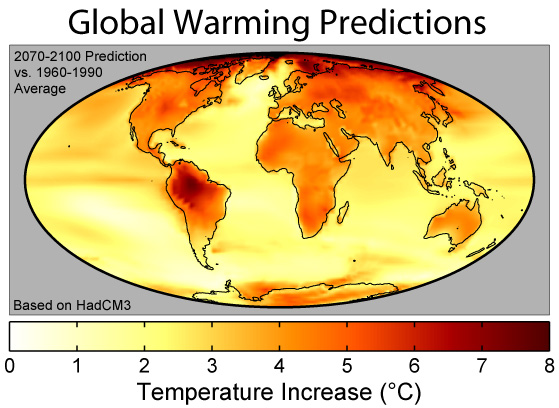
Second Degree of Change
When it comes to the second degree of temperature rise, this is called the "tipping point" and the "slippery slope." James Hansen from NASA is one who says the latter. It is entirely possible that there is absolutely no ice in the Arctic during the hot part of the year and there would be a "runaway train"…


